Wonder Woman

I went to see this at 6:00pm on a bright June Saturday, and there were so many excited little girls in the audience with their parents, and I just started crying right then. I had a wonderful time.

There are things we know about superhero movies. There will be expense, there will be quips, there will be booming music, there will be falls that look like they would really hurt. The final battle will drag on for too long, but even though the movie could have stood to be an easy 30 minutes shorter, you still enjoyed yourself for the period of time you spent in this big grand world, rooting for our champion to save us.

And Wonder Woman is all of those things, no more no less. There’s really only one difference here: you spend that period of time in a big grand world rooting for a lady champion. And this is what kept me crying (for half an hour longer than I should have).

There was this one moment in the latter half of the movie, when Diana is urging a swift horse through a forest, off to save someone, silver sword on her back, and for a few beats some Howard Shore-style horns rise into the score. “She’s Arwen,” I whispered to myself through a fresh wave of tears. Because she’s all of them, she’s every sidelined female hero I’ve ever met, like they all run through her. A lineage, an ancestry. A matriarchy. Every glorious, valiant woman in someone else’s story, finally given her own forest to run through — and her own forest to save.

Save us, Wonder Woman.

Logan

And here comes Logan. Here comes a hard, weary Western not even a year after the soapy absurdity of X-Men: Apocalypse. If this is the creative leeway you’re allowed when you’re Marvel’s second-fiddle franchise, then we should all be so lucky to be overshadowed.

Logan is the first true X-Men genre picture, wearing its Western heart on a torn sleeve. But while Shane may be directly referenced in the script, it’s far from the only cinematic influence at play here. The battered vehicles, the reluctant hero in the desert, and the warning of a world ruined by patriarchal capitalism — this is Mad Max. A dystopic near-future where no mutants have been born in decades, until a woman of color arrives with a miraculous child who must be transported to safety — this is Children of Men. A grim, blunt loner driving down a wilderness road with a fierce, traumatized young girl beside him — this is….the first X-Men movie.

Somehow it can all come back around, if you apply genre right. Sometimes that framework, that filter, can allow you to see the bones of a story more clearly.

Your usual superhero movie is a pretty stylized thing. Usually they go glossy; colorful as well, especially if it’s an X-Men picture. Logan is just as stylized as its family, only here it’s an anti-gloss, smudged with dirt and old blood. It’s scrubland and a big hot sky and gas station parking lots. It’s a gray, coughing Logan, body crumbling like the wall sheltering a gunslinger during his last shootout. It’s a dry, derelict water-tower shot through with holes, stars overhead as much as needles of light pinning an ill, elderly Charles Xavier to a stolen hospital bed.

For all the aesthetics, there’s also the raw and wrenching realism contained in that last part of that description. This is a comic book movie where Logan, the X-Men’s reluctant substitute teacher, is the only one left to care for 90-something Charles, stricken with an undefined degenerative disease. Where Logan has to constantly make sure Charles takes his medicine, lift him from his chair to his bed, help him use the bathroom. Many superhero movies are about death, but this one dares to be about dying.

It may seem odd to say that a movie so hard on its characters is good to them, but in this case I think it’s true. At the very least, Hugh Jackman and Patrick Stewart were given roles worthy of veteran actors, given material to really play in their last venture as Wolverine and Professor X. They’re even allowed to curse, given Logan’s R rating. That R rating also results in surely the most graphic violence we’ve seen out of Marvel. I have my doubts that this movie really needed fight sequences so brutal and so long, that the story wouldn’t have been just as strong with say, maybe half the head impalements? But at the same time, watching Logan and Laura claw through their enemies for each other brought me to tears, and not just once.

As did Laura herself. Our newest weirdo X-child, our troubled, screaming hope. In the final installment of the Wolverine film franchise, a superhero who has been both avatar and commentary on a fantasy of American masculinity, how incredible to close with the message that the future is female, and Latina.

[other X-Men reviews: X1 and X2, First Class and Days of Future Past]

Arrival

Much like with Moonlight, I hadn’t actually watched a trailer for Arrival. It had simply tallied up enough points. I knew that it is led by Amy Adams, playing a linguist trying to communicate with an alien species that has landed on Earth. I knew that the cinematography is by Bradford Young, whose career I’ve followed since Ain’t Them Bodies Saints. I knew the score is by a contemporary Icelandic composer, whom I now know is named Jóhann Jóhannson. And I knew that when it was released soon after the American election, people went to see it, and cried. And that was enough.

So, much like with The Handmaiden, I didn’t know there would be a twist. But I do know “twist” is an incomplete word to describe how Arrival works. Arrival only has a twist if you’re approaching it as a native speaker of Movie, assuming certain structures common to the language of cinema. Which of course we are, and which is how even the very form of the film is about the experience of learning a different language.

Arrival is beautifully designed like that. Arrival is just beautifully designed, full stop. The atmosphere rolls over you like the clouds spilling down around the motionless dark shell hanging in the air, rolls through you like the reverberant hums and simple lilting vocal notes of the score. Sometimes I’ve wondered if it’s cohesion of design that creates atmosphere. All the more remarkable here, if so, as it’s all deliberately atonal.

What unifies the design elements may be in the open spaces their atonal patterns leave for each other. Elision, noun — the omission of a sound or syllable when speaking; an omission of a passage in a book, speech, or film; the process of joining together or merging things, especially abstract ideas.

Time is an abstract idea given space here. Time is given to time, and Arrival, based on a short story published in 1998 and filmed in 2015, could hardly have arrived in theaters at a more fitting point in it. When we had need of thoughtfulness, and science, and careful communication showing a way through massing forces of militarized nationalism and distrust. When we had need of hope.

And what better genre for hope than science fiction. What better empty space for the thoughtful and abstract, than the idea of space itself.

Hidden Figures

The music in Hidden Figures is by Hans Zimmer and Pharrell Williams, a combo that goes a very long way to describing how this movie makes you feel: WONDERFUL. Zimmer, that orchestral boffin who gave us the instantly classic Pirates of the Caribbean score, brings it on the epic and exhilarating and heart-stirring, and Pharrell, who rose to fame on a song literally called “Happy”, just bursts in like a skinny Kool-Aid man splashing energy and style and hope all over the place.

Hidden Figures is a movie you tap your toes along to. Bouncing with the melody of it, in mirror neuron sympathy as Katherine races top-speed across the NASA compound with a stack of folders full of equations, jittery with nerves as the rockets strain toward the stars.

Actually, I think I can stretch for a metaphor here, I think this big feel-good tear-jerker is just strong enough to support it — you might be able to anchor this whole movie in the feet of women.

Mathematicians Katherine Goble, Dorothy Vaughan, and Mary Jackson wear heels to work. They are required to. The “uniform” of the women who work at NASA is brought up in the script on multiple occasions: skirts to the knees, sweaters preferred to blouses, no jewelry except a string of pearls — if you can afford them — and heels.

We see those heels a lot. Raining across the pavement in a rapid staccato every time Katherine is forced to run through the compound, clipping through the halls as Dorothy leads a phalanx of black “computers” to a new job.

And once early on, trying to literally drag Mary down when her heel gets stuck in a grate in the floor of a wind tunnel.

“No shoe is worth your life,” the lead engineer urgently intercoms from behind the glass as the fan picks up speed (this is the movies after all), and so Mary just ditches the thing, rushes in to safety, and then throws the other one off and dashes right up to the window to watch the experiment. Later, when she’s back out on the floor impressing her new boss with her natural instincts for engineering, she does so with her feet firm on the floor, heel still visibly wedged in and abandoned in the lower corner of the frame.

Forgive me my analogies, but society has so long sought to restrict the movement of women, and women of color especially. In Hidden Figures, all these figurative and literal constraints are held up to the light. And in Hidden Figures, these brilliant black women, battling against both racism and sexism with grace and flame, show they already have everything it takes to stand tall.

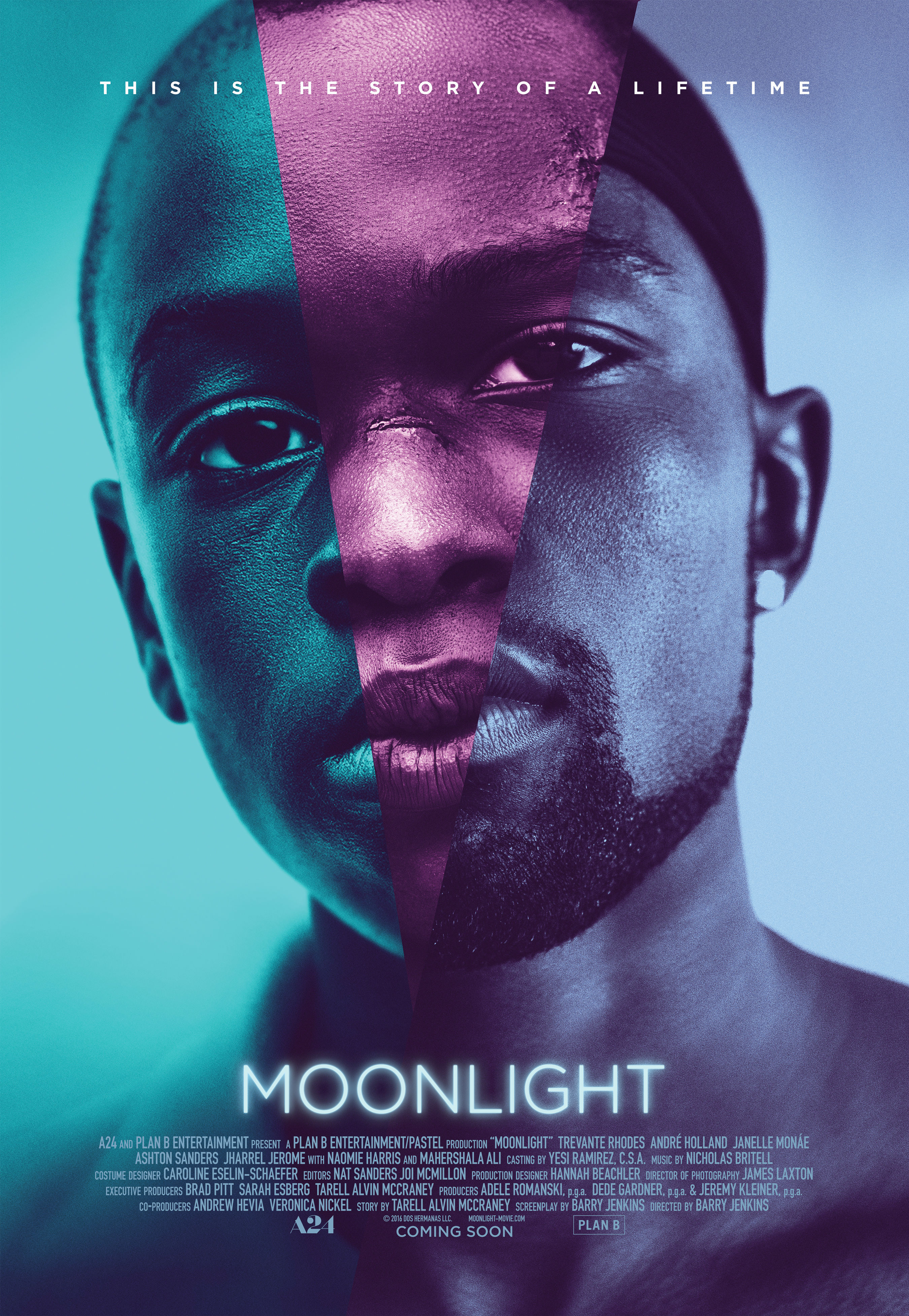
Moonlight

I was trying to describe Moonlight to a friend after I got back from the theater.

I told her critics are probably calling it lyrical and graceful, which it is, even though it’s the story of a great violence.

I told her it was a bildungsroman, but that was a stall; I told her it was the story of a black gay man growing up Miami.

I told her it was the movie embodiment of its poster, that it too is striking and beautiful. Beautifully constructed, beautifully colored.

I told her that I cried.

And that the first time I cried was watching little Chiron, when he was still Little, being taught how to swim by his kind and complicated father figure, a drug dealer, floating on his back in the ocean while Juan cradles his head and promises that he has him, that he won’t let him drown — and knowing that the rest of the world is not making this promise.

I cried on this beach again, under the moonlight, where black boys look blue, and I cried at the end, long after Little had become Black, at this moment built of the two that had come before, Little looking back, Black and blue.

It becomes increasingly hard to describe. It is not a hard movie, but it is about hard things.

What is strengthening about Moonlight, what makes you feel clearer and brightened after your tears, isn’t from watching the events that take place, but from being able to watch them at all. From being able to go to a movie theater and watch this story, and watch it told with a magical unguarded delicacy.

In the end, I’m not sure if I can describe Moonlight. But Hilton Als has written about it, so go see it, and then go to him.