Wonder Woman

I went to see this at 6:00pm on a bright June Saturday, and there were so many excited little girls in the audience with their parents, and I just started crying right then. I had a wonderful time.

There are things we know about superhero movies. There will be expense, there will be quips, there will be booming music, there will be falls that look like they would really hurt. The final battle will drag on for too long, but even though the movie could have stood to be an easy 30 minutes shorter, you still enjoyed yourself for the period of time you spent in this big grand world, rooting for our champion to save us.

And Wonder Woman is all of those things, no more no less. There’s really only one difference here: you spend that period of time in a big grand world rooting for a lady champion. And this is what kept me crying (for half an hour longer than I should have).

There was this one moment in the latter half of the movie, when Diana is urging a swift horse through a forest, off to save someone, silver sword on her back, and for a few beats some Howard Shore-style horns rise into the score. “She’s Arwen,” I whispered to myself through a fresh wave of tears. Because she’s all of them, she’s every sidelined female hero I’ve ever met, like they all run through her. A lineage, an ancestry. A matriarchy. Every glorious, valiant woman in someone else’s story, finally given her own forest to run through — and her own forest to save.

Save us, Wonder Woman.

Logan

And here comes Logan. Here comes a hard, weary Western not even a year after the soapy absurdity of X-Men: Apocalypse. If this is the creative leeway you’re allowed when you’re Marvel’s second-fiddle franchise, then we should all be so lucky to be overshadowed.

Logan is the first true X-Men genre picture, wearing its Western heart on a torn sleeve. But while Shane may be directly referenced in the script, it’s far from the only cinematic influence at play here. The battered vehicles, the reluctant hero in the desert, and the warning of a world ruined by patriarchal capitalism — this is Mad Max. A dystopic near-future where no mutants have been born in decades, until a woman of color arrives with a miraculous child who must be transported to safety — this is Children of Men. A grim, blunt loner driving down a wilderness road with a fierce, traumatized young girl beside him — this is….the first X-Men movie.

Somehow it can all come back around, if you apply genre right. Sometimes that framework, that filter, can allow you to see the bones of a story more clearly.

Your usual superhero movie is a pretty stylized thing. Usually they go glossy; colorful as well, especially if it’s an X-Men picture. Logan is just as stylized as its family, only here it’s an anti-gloss, smudged with dirt and old blood. It’s scrubland and a big hot sky and gas station parking lots. It’s a gray, coughing Logan, body crumbling like the wall sheltering a gunslinger during his last shootout. It’s a dry, derelict water-tower shot through with holes, stars overhead as much as needles of light pinning an ill, elderly Charles Xavier to a stolen hospital bed.

For all the aesthetics, there’s also the raw and wrenching realism contained in that last part of that description. This is a comic book movie where Logan, the X-Men’s reluctant substitute teacher, is the only one left to care for 90-something Charles, stricken with an undefined degenerative disease. Where Logan has to constantly make sure Charles takes his medicine, lift him from his chair to his bed, help him use the bathroom. Many superhero movies are about death, but this one dares to be about dying.

It may seem odd to say that a movie so hard on its characters is good to them, but in this case I think it’s true. At the very least, Hugh Jackman and Patrick Stewart were given roles worthy of veteran actors, given material to really play in their last venture as Wolverine and Professor X. They’re even allowed to curse, given Logan’s R rating. That R rating also results in surely the most graphic violence we’ve seen out of Marvel. I have my doubts that this movie really needed fight sequences so brutal and so long, that the story wouldn’t have been just as strong with say, maybe half the head impalements? But at the same time, watching Logan and Laura claw through their enemies for each other brought me to tears, and not just once.

As did Laura herself. Our newest weirdo X-child, our troubled, screaming hope. In the final installment of the Wolverine film franchise, a superhero who has been both avatar and commentary on a fantasy of American masculinity, how incredible to close with the message that the future is female, and Latina.

[other X-Men reviews: X1 and X2, First Class and Days of Future Past]

Arrival

Much like with Moonlight, I hadn’t actually watched a trailer for Arrival. It had simply tallied up enough points. I knew that it is led by Amy Adams, playing a linguist trying to communicate with an alien species that has landed on Earth. I knew that the cinematography is by Bradford Young, whose career I’ve followed since Ain’t Them Bodies Saints. I knew the score is by a contemporary Icelandic composer, whom I now know is named Jóhann Jóhannson. And I knew that when it was released soon after the American election, people went to see it, and cried. And that was enough.

So, much like with The Handmaiden, I didn’t know there would be a twist. But I do know “twist” is an incomplete word to describe how Arrival works. Arrival only has a twist if you’re approaching it as a native speaker of Movie, assuming certain structures common to the language of cinema. Which of course we are, and which is how even the very form of the film is about the experience of learning a different language.

Arrival is beautifully designed like that. Arrival is just beautifully designed, full stop. The atmosphere rolls over you like the clouds spilling down around the motionless dark shell hanging in the air, rolls through you like the reverberant hums and simple lilting vocal notes of the score. Sometimes I’ve wondered if it’s cohesion of design that creates atmosphere. All the more remarkable here, if so, as it’s all deliberately atonal.

What unifies the design elements may be in the open spaces their atonal patterns leave for each other. Elision, noun — the omission of a sound or syllable when speaking; an omission of a passage in a book, speech, or film; the process of joining together or merging things, especially abstract ideas.

Time is an abstract idea given space here. Time is given to time, and Arrival, based on a short story published in 1998 and filmed in 2015, could hardly have arrived in theaters at a more fitting point in it. When we had need of thoughtfulness, and science, and careful communication showing a way through massing forces of militarized nationalism and distrust. When we had need of hope.

And what better genre for hope than science fiction. What better empty space for the thoughtful and abstract, than the idea of space itself.

Hidden Figures

The music in Hidden Figures is by Hans Zimmer and Pharrell Williams, a combo that goes a very long way to describing how this movie makes you feel: WONDERFUL. Zimmer, that orchestral boffin who gave us the instantly classic Pirates of the Caribbean score, brings it on the epic and exhilarating and heart-stirring, and Pharrell, who rose to fame on a song literally called “Happy”, just bursts in like a skinny Kool-Aid man splashing energy and style and hope all over the place.

Hidden Figures is a movie you tap your toes along to. Bouncing with the melody of it, in mirror neuron sympathy as Katherine races top-speed across the NASA compound with a stack of folders full of equations, jittery with nerves as the rockets strain toward the stars.

Actually, I think I can stretch for a metaphor here, I think this big feel-good tear-jerker is just strong enough to support it — you might be able to anchor this whole movie in the feet of women.

Mathematicians Katherine Goble, Dorothy Vaughan, and Mary Jackson wear heels to work. They are required to. The “uniform” of the women who work at NASA is brought up in the script on multiple occasions: skirts to the knees, sweaters preferred to blouses, no jewelry except a string of pearls — if you can afford them — and heels.

We see those heels a lot. Raining across the pavement in a rapid staccato every time Katherine is forced to run through the compound, clipping through the halls as Dorothy leads a phalanx of black “computers” to a new job.

And once early on, trying to literally drag Mary down when her heel gets stuck in a grate in the floor of a wind tunnel.

“No shoe is worth your life,” the lead engineer urgently intercoms from behind the glass as the fan picks up speed (this is the movies after all), and so Mary just ditches the thing, rushes in to safety, and then throws the other one off and dashes right up to the window to watch the experiment. Later, when she’s back out on the floor impressing her new boss with her natural instincts for engineering, she does so with her feet firm on the floor, heel still visibly wedged in and abandoned in the lower corner of the frame.

Forgive me my analogies, but society has so long sought to restrict the movement of women, and women of color especially. In Hidden Figures, all these figurative and literal constraints are held up to the light. And in Hidden Figures, these brilliant black women, battling against both racism and sexism with grace and flame, show they already have everything it takes to stand tall.

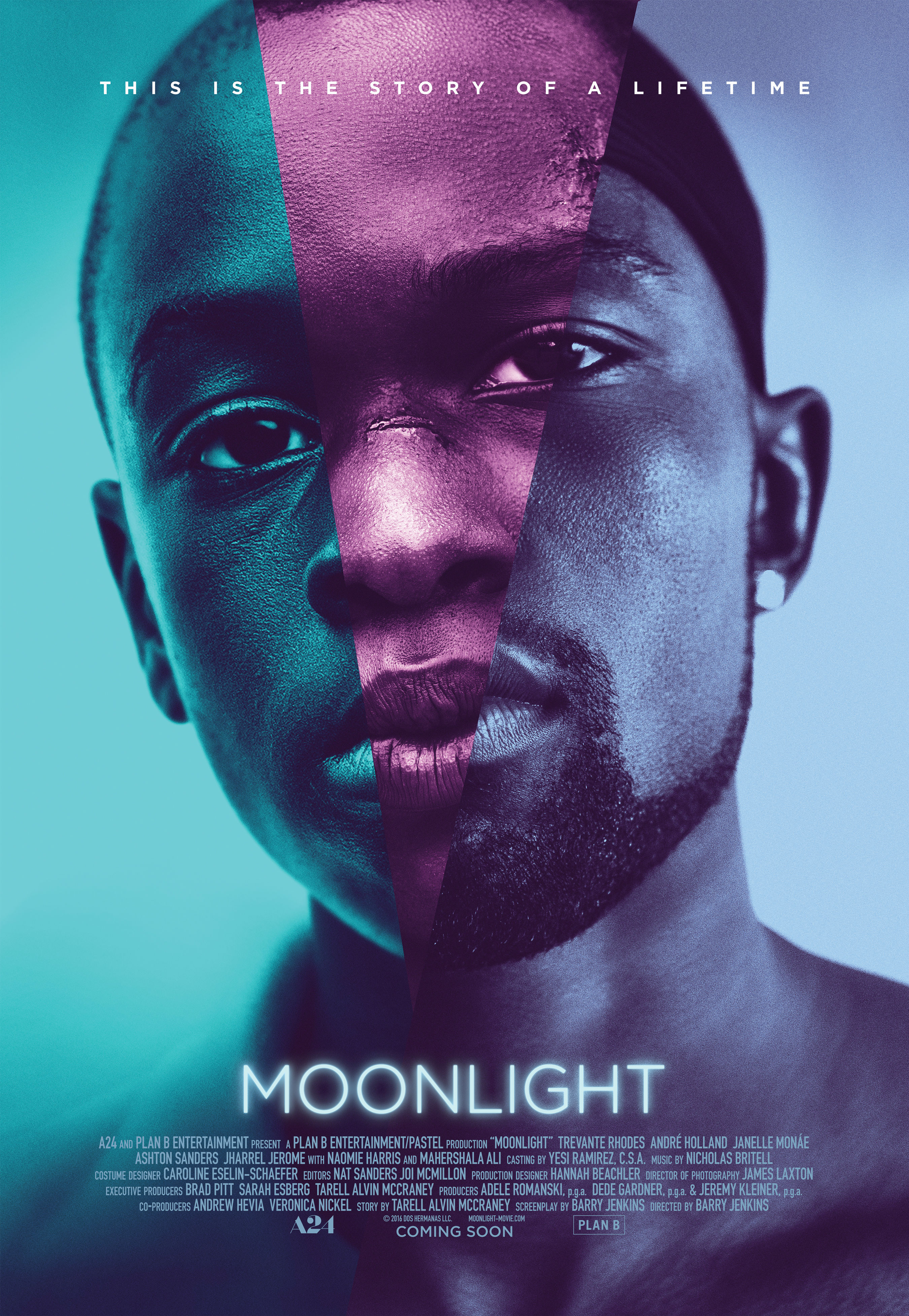
Moonlight

I was trying to describe Moonlight to a friend after I got back from the theater.

I told her critics are probably calling it lyrical and graceful, which it is, even though it’s the story of a great violence.

I told her it was a bildungsroman, but that was a stall; I told her it was the story of a black gay man growing up Miami.

I told her it was the movie embodiment of its poster, that it too is striking and beautiful. Beautifully constructed, beautifully colored.

I told her that I cried.

And that the first time I cried was watching little Chiron, when he was still Little, being taught how to swim by his kind and complicated father figure, a drug dealer, floating on his back in the ocean while Juan cradles his head and promises that he has him, that he won’t let him drown — and knowing that the rest of the world is not making this promise.

I cried on this beach again, under the moonlight, where black boys look blue, and I cried at the end, long after Little had become Black, at this moment built of the two that had come before, Little looking back, Black and blue.

It becomes increasingly hard to describe. It is not a hard movie, but it is about hard things.

What is strengthening about Moonlight, what makes you feel clearer and brightened after your tears, isn’t from watching the events that take place, but from being able to watch them at all. From being able to go to a movie theater and watch this story, and watch it told with a magical unguarded delicacy.

In the end, I’m not sure if I can describe Moonlight. But Hilton Als has written about it, so go see it, and then go to him.

The Handmaiden

This might not be the most useful review of The Handmaiden. Because this review is informed by the experience of a person who did not have an inaccurate idea of what The Handmaiden would be, but a distinctly incomplete one. Also I watched it in a very small theater with three very elderly couples, and have no way of knowing exactly how much impact those…interesting circumstances had.

Here is everything I knew going in: The Handmaiden is the newest film from Park Chan-Wook, adapted from a novel called Fingersmith, by Sarah Waters. The pun of the title has been maintained, bless, but the setting has been rather brilliantly transposed from Victorian Britain to 1930s Korea, when the country was under Japanese rule. The cinematography is by frequent Park collaborator Chung Chung-Hoon, who was the DP for Stoker. Stoker was actually the only Park Chan-Wook movie I had seen; this would become relevant while watching The Handmaiden. And finally: Harold, they’re lesbians.

The first thing I found out while watching it, is that Chung has done it again. I do not know how that man films greens this rich, but it’s extraordinary. And I actually do know a lot of this is him, not just the color correctors, because I’ve an audio engineer friend who saw the raw footage for Stoker as it was coming in to be processed, and was amazed at how pretty the colors already were. The Handmaiden was turning out to be another gorgeously shot movie, with a visual quality I’ve never seen outside of other Park/Chung projects. And so the movie tripped along doing its lush, stylized thing, the story dark but Stoker-dark, with a Stoker sort of humor throughout. A rewarding fact quickly emerged, which was that even with some gross men circling around, the movie thinks they’re gross too, and thinks the two women at the center is the good part, the part we should focus on, the part to care about and root for.

Then a huge plot twist happened, my mouth dropped open in shock, the screen read “Part Two”, and that’s when I realized I was in for a RIDE.

Part Two gets wild. Part Two does this utterly fascinating thing where it goes over many of the events of the first part again, but this time from the POV of the other woman at the center of the story. We’ll be shown the same exact scene but from a literal new angle, often continuing on to show what we now realize was a very relevant development that had been hidden from us during the first part. This is totally brilliant. But something else is also getting amplified in Part Two, and that is the horror. Park Chan-Wook makes bold and violent and disturbing movies. Beautiful, highly elegant and composed, but horrifying. I had happened to watch one of his relatively milder ones, so hadn’t realized just how far he’ll go with creepy, cruel content, of a sort that made me start to feel like I do in the middle of The Cook, The Thief, His Wife & Her Lover, when I wonder if I can even stand to keep watching this.

Very like The Cook, The Thief, His Wife & Her Lover, in fact. The Handmaiden too is aesthetically dazzling, contrasts sexual atrocities with sexual love, and is very explicit in its depiction of both. The sex scenes between the women are striking in their length and nudity, but in a development on the other shocking sequences, in these what is uncensored is an expression of care and pleasure. The central narrative importance of the joy Hideko and Sookhee find in sleeping with each other is being told in the same bold, exaggerated language already established, heightened compositions giving way to heightened sex scenes — which is one of several elements at play that has me dubious that criticism of the movie’s “male gaze” is really the most accurate way to address what is going on here.

Anyhow, The Handmaiden is not even done yet — following the astonishing Part Two is Part Three. The twists keep flipping into place like the smoothly clicking lenses at the optometrist’s office, each time making a clearer image, a better image. And as the story came into full focus, that’s when I realized I was being led into yet another surprise: underneath all the display and deception, beats a truly romantic heart.

The Addams Family, What We Do In the Shadows

A couple on-the-day Halloween watches to wrap up the Spooky Season, which for me apparently means mostly cheery-morbid comedies?

The Addams Family

I had never seen this before! Which I don’t think anyone will find more surprising than I did while watching it. All about those dark weird cobweb-chic aesthetics, a tone that puts the dead in deadpan, and a candy-sweet core. For The Addams Family is, in fact, about family, both formed and found, and it is deeply sincere about that. It’s sarcastic about other things — fear of death, silly societal “rules”, Freudian psychoanalysts — but not about familial love. It’s love that beats in the heart of the Addams’ haunted home, making it feel so creepily, delightfully alive. And at the heart of that is the particular love Gomez and Morticia have for each other — a wildly passionate, kinky, worshipful devotion between these long-married parents of two that is, hey, charming as hell.

In other news, Christopher Lloyd has become my Actor Of Autumn, showing up in a surprising number of things I’ve watched recently: Star Trek III: The Search For Spock, Clue, Over the Garden Wall, and now The Addams Family.

What We Do In the Shadows

I started giggling at the perfectly out of focus New Zealand Documentary Board logo that stayed on screen for two beats too long, and then did not stop. This is a mockumentary, I guess would be the first thing to know, following a group of vampires who live together in a flat in Wellington, New Zealand. It’s a slice of life, dealing with typical vampire domestic concerns like talking to that one flatmate who hasn’t washed his bloody dishes in five years, how to negotiate bringing over guests you’re going to drink, or ways to make sure the squad is looking good for a night out when you can’t see yourselves in a mirror.

You know the sort of hilarity that comes from masterful improv actors who know each other really well and have been given an incredible premise to play with? That’s this. An instantly quotable treasure.

Halloween Watches

Some on-season movies I’ve watched in the last handful of Octobers:

An American Werewolf In London

I have this idea that the pioneering works of a genre, the ones known to really be It, are often also the funniest entries in said genre. For instance, The Third Man is as much a brilliant comedy as it is one of the preeminent film noirs. An American Werewolf In London fits that same model: it’s a classic gory horror flick with some game-changing makeup & practical effects, and also hilarious. It’s particularly deft at sending up both British and American culture, and many different types of British culture at that. I mean I’m not saying this is the 1980s horror version of Gosford Park, but maybe I’m saying this is the first step a monster movie would take if it were trying to be that.

Clue

Several years back, I spent a Halloween characterized by thundersnow (oh yes) holed up with some friends eating pumpkin butter on oatcakes and watching Clue. This was a really excellent night and I can recommend it. Clue, in case you are unfamiliar, is indeed a murder mystery movie based on the board game, and contains some of the peak comedic performances of our time. In an homage to the re-shuffled nature of the game, they filmed three different endings, scattering the A, B, and C versions of the film across the cinemas. Nowadays, if you rent it on DVD, you have your choice of picking an ending at random, or watching all three in a row. This second is obviously the best option.

Ginger Snaps

Ginger Snaps is a creature feature about menstruation turning you into society’s monster, aka the feminist Canadian werewolf bildungsroman B-movie of your dreams. There is as much aggressive confrontation of gender roles as there is aggressively mauling dudes to death. Here’s your plot: über morbid teen goth sisters hate everyone in their dumb town, then one of them gets her first period and is immediately bitten by a werewolf. Here’s your actual tag-line: “They don’t call it the curse for nothing.”

Interview With the Vampire

I knew going in that Bryan Fuller loves this story, and that comparisons have been made between it and his Hannibal series, often by him, but I was unprepared for this being exactly the Murder Fam vampire AU. I think I could describe both with the same elaborate sentence, let’s do it: an arch, sumptuous danse macabre of eroticized consumption, in which a charming lonely monster who fancies himself a death-dealing god falls in love with a beautiful lonely man who feels too deeply, only to become exquisitely frustrated by his beloved’s refusal to accept his own murderous nature in favor of wracking himself with guilt, and so creates a monster daughter for them to raise together — a plan which goes spectacularly, brutally wrong. Ta-da, pretzels is the same. Anyhow they’re both fabulous.

Over the Garden Wall

Over the Garden Wall is one of my favorite things ever. It’s 10-episode animated miniseries, but each episode is only about 10 minutes long, so it’s basically just a movie with chapters. It tells the story of two young brothers who are lost in some woods called The Unknown, because at its core, this is a meta-story about stories. Over the Garden Wall is interested in family and heroism and friendship and monsters and love, and how well we can still tell those stories today through old archetypes and new fairytales. It’s an incredibly smart and sincere little show, and honestly that would have been enough, but then they also did an absolutely beautiful job on every other element too. The art design, the voice actors, the original music, the jokes — all are so, so good. It’s a treat, a perfect Halloween treat.

Practical Magic

This would be a qualified sort of recommendation, because I think this movie has some of the oddest, clunkiest pacing I’ve ever seen. But while I don’t feel that they came together very well, I very much like the parts as parts! Gorgeous witch house: yes. Three generations of witch sisters: yes. 1990s witch fashion: yes. This might be one of those movies that’s best if you just have it on while you make caramel apples or something, I think it could be really nice for that.

Sleepy Hollow

I watched this last Halloween for Emmanuel Lubezki’s cinematography, No. 1 reason. Perhaps this is why I find I cannot remotely recall the plot, but can recall desperately wishing to throw a glamorous old-fashioned Halloween party with this exact aesthetic. I think there are actually just two flavors my Halloween mood comes in — one is red-leafed American suburbia, and the other is the foggy, twisty, vaguely 19th-century thing going on here. Anyway, come for the #looks, stay for the #looks.

STAR TREK: II, III, VI, VI, (2009), and Beyond

My apologies for the lapse in movie reviews over here! I’ve been spending all my watching-things time on an epic Trek trek through 50 years and 5 series of optimistic sci-fi space adventures. It’s been GREAT.

I’ve fallen in love with the sweetly domestic ensemble work in Deep Space Nine, and have developed some form of retro-grade nostalgia over Voyager, but I instantly fell heart over heels for The Original Series, a silly beautiful starry cheese platter that I love tremendously. By this point I have watched 6 movies with the TOS characters, on what was supposed to be a light jaunt into one part of the franchise. My god, Jim. Anyhow, to keep with the film-focused theme of this watch log, here are my collected thoughts on the Star Trek movies I’ve seen. Spoilers for the 1980s.

Star Trek II: The Wrath of Khan

“Ah Kirk, my old friend. Do you know the Klingon proverb that tells us, ‘Revenge is a dish that is best served cold’? It is very cold, in spaaace.”
– Khan

As far as I can figure it, there are two things that make The Wrath of Khan terrific. One is Ricardo Montalbán as Khan, who looks utterly early-80s ~apocalyptic fabulous~ while serving up this richly literary villain, glamming ruthlessly around like Milton’s War King of the Wasteland. He is singularly fixed on destroying Kirk, as if humanity’s attempt to create our next Napoleon produced Ahab instead. That’s kinda brilliant as a commentary on the Genesis project — we never know what playing God might unleash. And keeping it personal is also a perfect plot choice, because the standard blockbuster threatening of the world or the galaxy is always grand beyond our reckoning, and our feelings. What we truly care about is the fate of the characters we love.

Which is the other great thing about The Wrath of Khan: our selfless, brave Mr. Spock. Probably I should have figured out I was going to spend this whole movie emotionally caught off-guard by known facts, when despite, y’know, the title, I literally gasped when we saw “SS BOTANY BAY” stamped on some space hardware. So it didn’t matter that I already knew this was that famous Star Trek story where Spock “dies”, that I even knew that needs to be in quotes because he’ll obviously come back — I lost it. I cried out when Spock put his hand up against the glass, I was choked up beyond all reason during Jim’s eulogy. Then Scotty started playing “Amazing Grace” on bagpipes, and that was it, in TEARS.

Also very affecting: the over-all theme of confronting aging, and what it really means to feel young. It was like I was personally tangled up in it, watching these older versions of characters I’d met when they were decades younger. My heart kept turning over like when I went back to watch the Sirs in the original X-Men movies — old men now, but oh, their spirits are just the same.

Star Trek III: The Search For Spock

“This business with Spock and McCoy….”
– Admiral Morrow

I actually skipped this one initially, which would have been a tragic loss. Things I adore: a haunted starship, spooky telepathy shenanigans, HEISTS, sass & badassery, wildly absurd plots, and the odd tangled intimacy between Bones and Spock. Things this movie had: all of those.

I’d gotten myself all captivated by Spock and McCoy’s relationship while watching TOS. There’s a triangle at the center of the Enterprise, for Bones loves Jim, Spock loves Jim, Jim loves them both, and Bones and Spock do not know what this makes them to each other. Mostly they snip and banter and act like their relationship is just a begrudging tactical alliance, but this breaks down fascinatingly when Jim is taken out of the picture through some plot or other. It’s like without Captain Kirk’s gravitational pull holding them in orbit, Spock and McCoy collapse toward each other, with both flares of real anger and strangely helpless openness. Ultimately, they have a profound understanding built out of the shared knowledge that they will each do anything for Jim Kirk. It’s a really interesting connection, existing only between two people but because of a third.

In The Search For Spock, their leg of the triangle has gotten collapsed, Spock having placed his mind in the soul of Dr. McCoy through a Vulcan safekeeping measure to preserve life in the event of the body’s death. This obviously renders the triangle unsteady as hell. Which is how Kirk ends up accosting a senior officer like, “listen, my two best friends have fused their spirits and I have to get them into separate bodies so that I can resume my proper place in the middle of this emotional sandwich — now give me my damn ship back so that I can fly off to literal Forbidden Eden.” Which, in turn, is how I often ended up feeling like this movie was a weird gift for me personally.

Star Trek IV: The Voyage Home

“Admiral! There be whales here!”
– Scotty

Proposal: that there probably could not be a more perfect Star Trek movie than one where a giant space cylinder is very dramatically humming the Earth into a powerless rain-ravaged cloudball… just because it wants to say ‘hey’ to some whales, which our team of renegade explorer-scientist best friends must TRAVEL BACK IN TIME to fetch up in their STARSHIP. Honestly, I kinda want to put this movie in a vault on behalf of Humanity.

What I think’s so special about The Voyage Home is that even with its big movie budget and big movie shape, it still has that culty, far-flung zany sweetness that characterized TOS. It is so ridiculous, and so ridiculously pure. The stakes are the planet, but the stakes are also Spock tearing off a strip of his monk bathrobe and tying it around his head to hide his ears, while Jim gazes at him like he’s the weirdo sun that gives off all the light in his life. It’s the horrified hilarity of realizing they’ve sent the Russian to seek out the “nuclear wessels” in Cold War San Francisco. It’s adding a lady scientist who is as wonderfully independent as she is curious and kind. It’s Dr. McCoy shedding his fantastic flight jacket and sneaking into a 20th century hospital to Save Chekov, and also Be Appalled. It’s watching Sulu deftly figure out how to fly a helicopter, learning that Uhura adorably pronounces the ‘H’ in ‘whales’, and getting completely overcome with emotions when the crew sees their Enterprise again. Though perhaps most of all, it’s Spock explaining gently and seriously: “They like you very much, but they are not the hell your whales.”

Basically, The Voyage Home was just two hours of me grinning and placing a hand on me cheek. This is a perfect movie.

Star Trek VI: The Undiscovered Country

“Quite correct, Mr. Chekov. What is required now is a feat of linguistic legerdemain and a degree of intrepidity, before the Captain and Dr. McCoy freeze to death.”
– Spock

I instantly agreed to watch this one when I was told it involved Kirk and Bones getting stranded on an ice planet, given my fondness for ICE PLANETS. It did not disappoint. In fact, through a series of events I’ll not bother to explain, this ice planet was the setting for one of my favorite moments of this entire TOS journey: Bones, completely bedecked in furs and scarves, conked flat out on his back like an unconscious snow angel, and then a tango of William Shatner grappling with William Shatner literally rolls over him. There seems to be a metaphor for McCoy’s life in this, I think.

Other highlights included:
– multiple sightings of starship-issue tea sets, which I must have immediately
– Sulu being the captain of his own ship
– candles!Spock
– a reference to Shakespeare “read in the original Klingon” that was so not a one-off that by the end I swear one of the Klingons was speaking exclusively in Shakespeare lines
– GRAVITY LOSS
– learning James Kirk’s middle name is Tiberius
– and that time the Enterprise became an Agatha Christie “the killer is among us” murder mystery

Overall, a pretty solid send-off for the original cast! Come for Bones in the snow, stay for Bones in the snow chattering fondly, “Why that cunning little Vulcan…”

Star Trek (2009)

“Don’t be such an infant.”
– Bones

WELL THIS WAS REALLY DISORIENTING.

If it were just stylistic differences due to the staggering advances in film technology over the decades, well that would be one thing. I could totally settle into contemporary lighting and camerawork the way I settled into the ‘80s Star Trek movies after watching TOS. But the style shift spilled over into the spirit of the movie too. To be honest, it’s probably partly due to how many filmmakers these days like to show off their movie magic abilities through destruction — more explosions, more stunts, more shatter and boom — and so in turn, their plots tend to revolve around conflict, conflict, conflict. So I guess this could be responsible for how we went from cozy colorful space adventures with your friends, to a lot of flashy hostility in a high-flying Apple store.

And y’know what was so demoralizing? That I distrusted even the eventual tableau of camaraderie in the final shots, because I still distrusted the heart of this new Captain Kirk. But thank god, I went to see Star Trek Beyond before writing anything, so I can spare you all a lengthy discussion of what is lovable and heroic about William Shatner’s Kirk’s grandiose self-confidence, compared against the entitled arrogant jerk they saddled Chris Pine with at first.

One thing I do want to mention quickly though before jumping ahead to — against incredible odds, Zachary Quinto found something really wonderful here in his impossible task of being New Spock, while our beloved Leonard Nimoy was also there being Spock. And that’s on top of having to make his way through a plot expressly designed to Break This Sad-Eyed Vulcan in every act. My god, that got so cruel…

Anyhow, most everything else I’d have to say is either irrelevant now or AMPLIFIED IN GOODNESS in:

Star Trek Beyond (2016)

“Mr. Sulu, you can…fly this thing right?”
“You kidding me, sir?”

AND I WEPT WITH HAPPINESS, AND MY TEARS WERE THE *STARS*

I hardly even know where to begin! Literally everything was better, I mean they even smashed up that cold, glossy white ship and put the crew back in THE ENTERPRISE, with grays and colors and proper Treksome blockiness. And this one was about Hope again, and being brave & brilliant not for your own glory, but always to help one another. This is what I love about Star Trek.

It is high time to mention Karl Urban, who must have a circle of rose quartz in his trailer and is keeping a steady channel open to DeForest Kelley. He is a perfect Leonard McCoy, his Bones feels good and right and sometimes I get all teary and emotional just watching him. He also brings something fresh and interesting — which is an important thing in these reboot projects and I’m a staunch advocate for it — in how his Bones is significantly more able and likely to just manhandle you into sitting still and getting healed, damnit, which is a look I find I really like on Dr. McCoy.

And then they paired him off with Spock for the significant majority of this one, so I was on SPACE CLOUD NINE. Bones’ constant grumpy attentive doctoring! Spock’s constant collapsing and begging McCoy to leave him and go save Jim! Having real talks about ~feelings~ because fuck it, we’re probably gonna die. My morbid bickering sweethearts. Plus, another rendition of one of my favorite things from the series: Spock and Bones’ tacit agreement to each shoulder a share of some painful knowledge they must keep from Jim, following their unspoken accords as the members of the Jim Kirk Protection Squad. Roll me into an alien sun about it honestly.

Heavenly Creatures

When I went to rent Heavenly Creatures from my retro video rental store, as you do, the same employee who had abstained from mansplaining Blade Runner to me was delighted with my choice. It was real good, he assured me, but DARK. “Who would have thought that guy would go on to direct Lord of the Rings?” he chuckled, in wonder. “Oh I like that though!” I told him. “I followed up Mad Max with Babe.” Not 2 brag but based on his face I think I’m now his favorite customer.

You do sometimes get these funny filmographies though, where a director seems to make more genre jumps than their peers. And I really do like that, a lot, because setting Mad Max and Babe next to each other, movies that at first glance seem pretty far apart, ends up telling you so much more about who George Miller is as a storyteller than simply watching the Mad Max series and nothing else.

But we’re not talking about my dear Australian grandfather today, we’re talking about the works of my oddball New Zealander uncle, Peter Jackson. It turns out that things about the Lord of the Rings trilogy that I would have thought unique to his Middle Earth are hallmarks of his whole approach. It actually starts in the approach, how here too he and Fran Walsh spent so much time with the source material, learning it inside out and wholeheartedly, so that the screenplay they crafted came from a place of rather remarkable sensitivity. Just like how they dug into Tolkien’s dense world and pulled up these incredible relationships between characters, they dug into a sensational 1950s murder trial and pulled up the twisted yet deeply profound connection between the two girls at the center of it. And then they shot both with the same DP, Alun Bollinger, bringing what I now see are his trademark shots — looming close just below someone’s nose as the ceiling stretches around them, flying wide from a helicopter over a figure running across the hilltops of New Zealand, and all the others you know and love from LOTR.

The girls though, the girls still are the center of it all. Headstrong, manic Juliet, who adores fanciful stories and tenor Mario Lanza as much as she loathes Christianity and Orson Welles: passionately. And loving, brooding Pauline, the anti-hero with a thousand names: Yvonne at home, Paul at school, and in Borovnia, the vivid, violent fantasy kingdom she and Juliet build, she’s Gina, her sister, or Charles, her lover. Juliet though is only ever Debora, always Debora. Always the two of them, always running running running, flashing like a pair of laughing Furies. Morbid, hedonistic young witches, prophetesses of a glowing dream realm of art and madness — the Fourth World, where “compared with these two, every man is a fool.” And so they go, falling into each other’s arms and a bloody folie à deux.

Lightly spoilery note: Once again I find myself writing about a story featuring Gay Villains, but once again I feel like the movie has made an effort not to damn them for this specifically. It is clear that we are to judge the girls for their true crime, murder, and not for how they love each other. The glorified psychiatrist who pronounces Pauline’s proclivities a sickness is depicted as misguided and gross, and when Juliet’s father will not stop obsessively prying and fretting over his daughter’s relationship, her mother tiredly admonishes him: “Just leave them alone, Henry.” Yes, Henrys of the world, just leave the queer girls alone. It does not concern you, by definition.